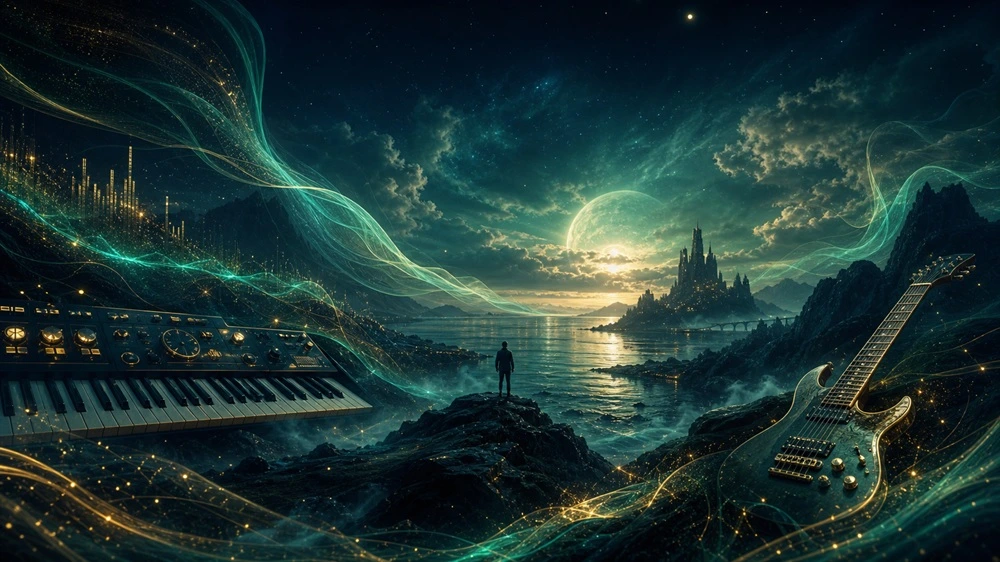

Symphonic progressive rock atmosphere and musical composition

Progressive rock song structure Suites, recurring themes, transitions, movements and musical storytelling

Musical architecture

A song can
become a journey.

Progressive rock does not reject the verse-chorus format, but it often moves beyond it. A song can unfold as a suite of connected sections, each with its own rhythm, texture, harmony and emotional purpose.

A progressive composition may begin with a simple motif, travel through contrasting instrumental passages, return to an earlier theme in a transformed form and reach a final climax that gives meaning to the entire journey.

Structure is where the instruments of progressive rock become a unified narrative. Drums shape transitions, bass creates harmonic movement, guitar develops motifs, keyboards build atmosphere and vocals can guide the listener through the story.

1 Opening idea
Possible paths
1 Coherent journey

Form Direction, contrast and return

Beyond repetition

A composition with room to evolve.

Progressive rock structure is built around development. Rather than repeating a limited number of sections in the same way, a composition can introduce ideas, transform them and return to them later from a different emotional or sonic perspective.

The goal is not complexity for its own sake. A strong progressive structure gives every transition a reason and allows each new section to feel connected to the larger musical story.

Learn to compose prog

Building blocks

Ideas that
keep moving.

Progressive structure depends on the relationship between sections. Themes recur, tempos change, textures expand and silence can be as important as sound. Each element helps the composition travel forward.

01 Identity

The motif

A melodic, rhythmic or harmonic motif gives a composition an identity. It can return later in a new register, tempo or texture.

02 Contrast

The movement

A movement is a distinct section with its own atmosphere, pulse and function, often creating a new chapter within the same song.

03 Connection

The transition

Transitions connect different musical worlds through a fill, a sustained chord, a tempo shift, a new texture or a moment of silence.

04 Development

The instrumental passage

Instrumental sections allow themes to evolve without lyrics, revealing dialogue between guitar, bass, drums, keyboards and textures.

05 Resolution

The climax

A climax gathers energy, harmony, rhythm and emotion into a decisive moment that gives the journey a sense of arrival.

06 Memory

The return

When an earlier theme returns, it creates recognition and coherence, especially when transformed by new harmony or instrumentation.

Structural models

Common forms in progressive rock.

There is no single progressive rock formula. The genre uses several recurring structural approaches, adapting them to the needs of the composition, the concept and the instruments involved.

Suite

Several connected movements form a single long composition, often with contrasting tempos, moods and instrumental centres.

Cyclical form

Themes return throughout the piece, creating unity while each recurrence is changed by new harmony, rhythm or arrangement.

Narrative form

The music follows a lyrical or conceptual storyline, using sections and motifs to reflect changes in character or setting.

Expanded song

A familiar verse-chorus foundation is extended through bridges, instrumental development, shifting meters and a transformed finale.

I Every instrument can become a structural voice.

Instrumental architecture

How instruments shape the form of a progressive song.

A progressive structure is not created by sections alone. It is created by the way instruments introduce, transform and resolve each musical idea. The rhythm section can change the pulse, a keyboard can introduce a new landscape and a vocal line can give meaning to an earlier motif.

Drums can mark changing meters and transitions. Bass can create harmonic movement between sections. Guitar can develop riffs, arpeggios and themes. Keyboards can transform atmosphere and create orchestral bridges.

The Mellotron can signal a symphonic transition, while atypical instruments introduce a new colour or setting. Finally, vocals can guide the narrative and bring emotional focus to the full composition.

One possible journey

A five-stage progressive composition.

This is not a fixed rule. It is a practical illustration of how a progressive song can move from an initial idea to a transformed conclusion while preserving coherence.

01

Introduction

A motif, texture, rhythm or lyrical phrase establishes the first atmosphere and suggests the world of the composition.

02

Expansion

New instruments, harmonies or rhythmic layers develop the initial idea and lead the music into a broader section.

03

Contrast

A shift in tempo, meter, dynamics or instrumentation introduces a contrasting movement and renews the listener’s attention.

04

Climax

The composition gathers its strongest melodic, rhythmic and emotional elements into a major instrumental or vocal peak.

05

Return

An earlier theme returns in a transformed form, creating resolution, memory and a sense that the journey has meaning.

Questions and answers

FAQ: progressive rock song structure.

Essential answers about suites, movements, recurring themes, transitions and musical storytelling in progressive rock.

What is progressive rock song structure?

Progressive rock song structure often uses multiple sections, recurring themes, instrumental movements, dynamic contrast, changing meters and transitions instead of relying only on a repeated verse-chorus format.

Why are progressive rock songs often long?

Progressive rock songs are often long because they develop several musical ideas, allow instrumental passages to evolve, revisit themes and create a larger narrative or suite-like form.

What is a recurring theme in progressive rock?

A recurring theme is a melody, rhythm, lyric or harmonic idea that returns later in a composition, sometimes transformed in tempo, instrumentation, harmony or dynamics.

How do instruments shape progressive rock song structure?

Drums can signal meter changes, bass can create harmonic movement, guitar can develop riffs and motifs, keyboards can create transitions, Mellotron can add orchestral texture, atypical instruments can introduce new colours and vocals can guide the narrative.