
Zeuhl Progressive Rock: definition, history, essential bands and classic albums
What Is Zeuhl Progressive Rock?
Zeuhl is one of the most original and distinctive subgenres of French progressive rock. Emerging in France in the late 1960s with the legendary band Magma, Zeuhl blends jazz fusion, classical composition, avant-garde music and powerful vocal arrangements into a singular progressive style.
The genre also created its own musical universe, including the fictional Kobaïan language developed by Magma, which gives Zeuhl a unique identity at the crossroads of progressive rock, opera, jazz-rock and experimental music.
Unlike many progressive rock styles focused primarily on instrumental virtuosity, Zeuhl is known for its hypnotic rhythms, repetitive bass-driven structures, spiritual atmosphere and dramatic musical storytelling.
Closely associated with the French progressive rock scene, Zeuhl influenced many artists looking for a more experimental and emotional approach to progressive music. Its legacy remains an essential part of the history of French prog rock.
Origins of Zeuhl and the Magma Revolution
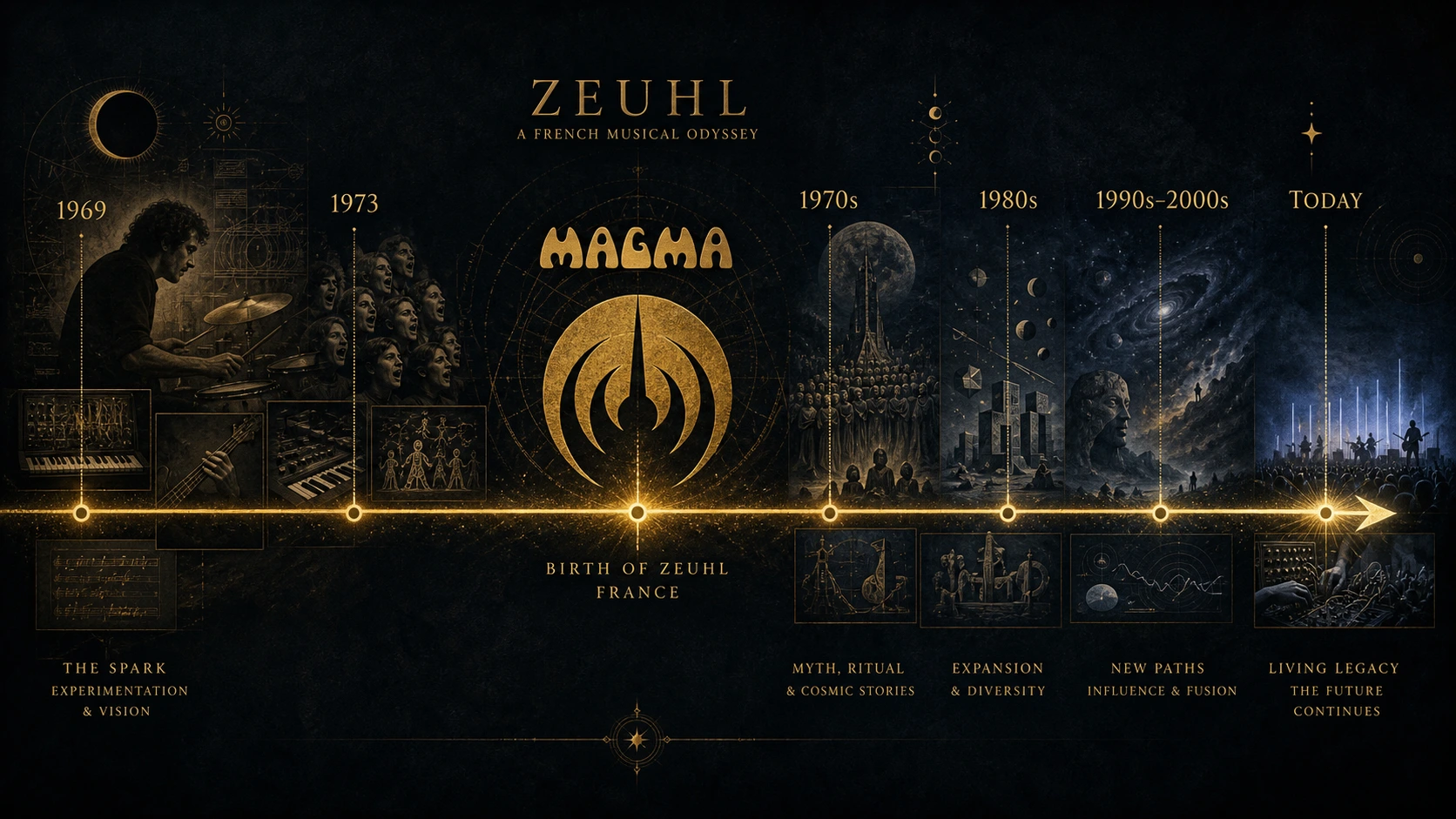
The history of Zeuhl begins with Magma, founded in France in 1969 by drummer and composer Christian Vander. Inspired by jazz pioneers such as John Coltrane, classical composers and contemporary experimental music, Magma created a completely original musical universe that became the foundation of the Zeuhl movement.
Magma’s compositions introduced massive rhythmic structures, powerful choirs, unconventional vocal techniques and a unique conceptual universe built around the fictional planet Kobaïa and its invented Kobaïan language.
Through this revolutionary approach, Zeuhl became one of the most distinctive branches of French progressive rock and a major influence within the international progressive rock scene.
Key Characteristics of Zeuhl Music
- Hypnotic and repetitive rhythms driven by powerful bass lines and shaped by jazz fusion, minimalism and experimental composition.
- Dramatic vocal arrangements featuring powerful choirs, operatic influences and Magma’s distinctive Kobaïan vocal style.
- Jazz fusion influences, especially the spiritual intensity and exploratory spirit of John Coltrane.
- Classical and avant-garde elements creating complex structures influenced by modern composition and experimental music.
- Cosmic, mystical and philosophical atmospheres often connected with the Kobaïan universe and visionary concepts.
- Long-form compositions built around evolving musical narratives, progressive development and immersive storytelling.
Essential Zeuhl Bands
Magma remains the founding band and essential reference point of the Zeuhl movement. Over time, several artists from France and abroad developed their own interpretations of Zeuhl, helping shape the evolution of this unique branch of French progressive rock and experimental music.
| Artist | Country | Contribution to Zeuhl |
|---|---|---|
| Magma | France | Founding band of Zeuhl and creator of the Kobaïan universe. |
| Koenjihyakkei | Japan | Highly technical and intense interpretation of Zeuhl-inspired progressive music. |
| Eskaton | France | Mystical and symphonic approach closely associated with the Zeuhl tradition. |
| Shub-Niggurath | France | Dark, avant-garde progressive music influenced by the French underground scene. |
| Zao | France | Jazz-rock fusion with progressive experimentation and Zeuhl-related elements. |
| Weidorje | France | Direct continuation of the Magma tradition through powerful rhythms and Zeuhl-inspired compositions. |
Essential Zeuhl Albums
These essential Zeuhl albums highlight key milestones in the development of the genre. From Magma’s pioneering recordings in the 1970s to later interpretations by international artists, they illustrate the diversity and distinctive sound of the Zeuhl universe.
| Album | Artist | Year |
|---|---|---|
| Mëkanïk Dëstruktïẁ Kömmandöh | Magma | 1973 |
| Köhntarkösz | Magma | 1974 |
| Üdü Ẁüdü | Magma | 1976 |
| 4 Visions | Eskaton | 1981 |
| Les Morts Vont Vite | Shub-Niggurath | 1986 |
| Hundred Sights of Koenjihyakkei | Koenjihyakkei | 1994 |
For a curated selection of landmark recordings, explore best Zeuhl and RIO albums or discover the Zeuhl and avant-prog bands that pushed the boundaries of progressive music.
Zeuhl and French Progressive Rock
Zeuhl is one of the most original expressions of French progressive rock and a distinctive part of the international prog scene. While British bands such as Genesis, Yes and King Crimson helped shape the first major wave of progressive rock, French artists developed their own identity through experimentation, theatricality, complex compositions and a strong avant-garde tradition.
Developed by Magma and later expanded by several influential artists, the Zeuhl movement remains a key reference for musicians interested in powerful rhythms, innovative vocal approaches and ambitious forms of musical storytelling.
Today, the legacy of Zeuhl continues to influence contemporary French progressive rock bands that balance melody, atmosphere, experimentation and progressive composition.
Discover also the wider history of progressive rock, the evolution of French progressive rock, the modern edge of progressive metal and the music of contemporary French prog band Quetzal.
Frequently Asked Questions About Zeuhl
What is Zeuhl progressive rock?
Zeuhl is a distinctive subgenre of French progressive rock that emerged with Magma in 1969. It blends jazz fusion, classical influences, powerful rhythms, dramatic vocals, experimental composition and mystical atmospheres.
Who created the Zeuhl genre?
Magma created the Zeuhl genre. The band was founded in 1969 by drummer and composer Christian Vander and introduced the fictional Kobaïan language, mythology and musical universe.
Why is Zeuhl considered unique?
Zeuhl stands out through hypnotic rhythms, bass-driven structures, powerful choral arrangements, invented languages and a blend of jazz, classical music and avant-garde experimentation.
Which bands are associated with Zeuhl?
Magma is the central reference point, while bands such as Eskaton, Weidorje, Shub-Niggurath and Koenjihyakkei developed related or Zeuhl-inspired approaches to progressive music.
Is Zeuhl still influential today?
Yes. Zeuhl remains a niche style, but it continues to influence progressive and avant-garde musicians, especially in Europe and Japan.